

What Is GEO? GEO vs SEO (Hong Kong 2026 Guide)
MC
Short answer: GEO (Generative Engine Optimization) is the work of getting AI search tools — Google AI Overviews, Google AI Mode, ChatGPT, and Perplexity — to cite, mention, or recommend your brand when they answer questions. SEO aims to rank high in classic results; GEO aims to appear inside AI-generated answers. They share the same foundation: GEO builds on SEO; it does not replace it.
Author: MC (Marcus), Native4a founder, 9 years of Hong Kong SEO | Last updated: October 2026 | For: Hong Kong SMEs and marketers exploring AI search
Contents
- What is GEO? One-line definition
- 3-minute key takeaways
- GEO, AEO, AI SEO — what’s the difference?
- GEO vs SEO
- Where Hong Kong users see AI answers
- How AI chooses which sites to cite
- What GEO work actually includes — 5 steps
- How to measure GEO
- Real case: one page lifts rankings and AI mentions
- 4 common misconceptions
- Who should do GEO — and who can wait
- FAQ
What is GEO? One-line definition
GEO (Generative Engine Optimization) improves the odds that AI search answers cite and recommend your brand — through site content, structured data, and third-party mentions.
“Generative engines” create answers: the user asks, the AI synthesises multiple sites into a summary, often with source links. The name comes from the 2023 paper “GEO: Generative Engine Optimization”.
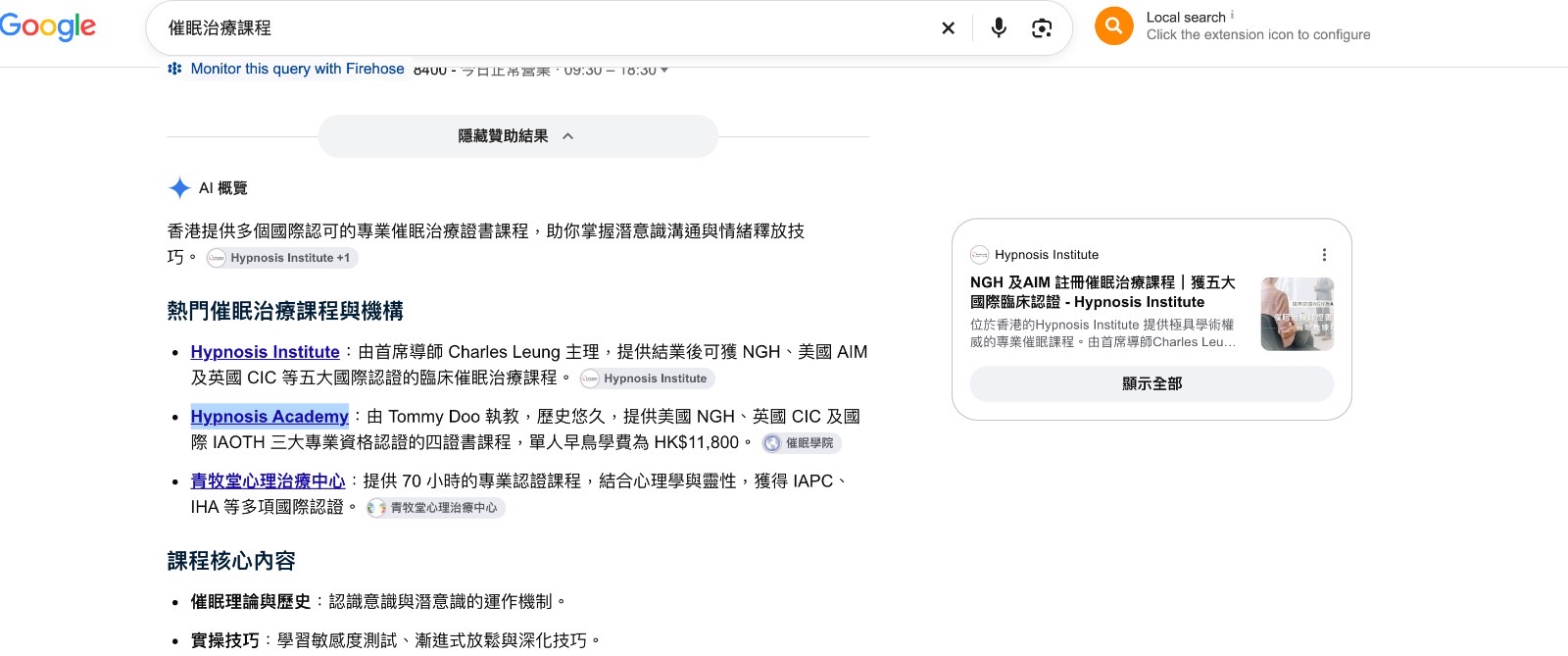
Hong Kong example: searching “hypnotherapy courses” used to mean ten blue links. Now an AI Overview may list recommended courses first. GEO is about whether your brand appears in that answer.
【Screenshot slot 1: Google AI Overview for hypnotherapy courses — /images/hypnosis-ai-overview-1.jpg. alt: “Google AI Overview example recommending hypnotherapy courses”】
3-minute key takeaways
- GEO doesn’t replace SEO: AI Overviews/Mode rely on Google’s index — pages need crawlability and baseline rankings.
- AI prefers answer-first content: direct openings, comparison tables, clear steps, FAQs, concrete facts.
- Brand data must be consistent: name, address, phone, services across site, Google Business Profile, and directories.
- Third-party mentions matter: comparison articles, press, directories help AI cross-check you.
- You can’t buy AI answers: treat “guaranteed ChatGPT recommendation” as a red flag.
- Measure with fixed questions: same prompts, same platforms, monthly retests, keep screenshots and cited URLs.
Native4a field note: many teams treat GEO like a new ad product. What usually decides AI mentions is whether one page clearly answers the buyer’s question.
GEO, AEO, AI SEO — differences?
| Name | Meaning | In practice |
|---|---|---|
| GEO | Generative Engine Optimization | Get AI answers to cite/recommend you |
| Generative search optimisation | Chinese label for GEO | Same |
| AEO | Answer Engine Optimization | Highly overlapping with GEO |
| AI SEO | Industry shorthand | Usually includes GEO work |
Bottom line: different labels, same core — make AI understand, trust, and cite you. This article uses “GEO”.
GEO vs SEO
| Item | Classic SEO | GEO |
|---|---|---|
| Goal | Rank in SERPs | Be cited/mentioned in AI answers |
| Surface | Ten blue links | AI Overviews/Mode, ChatGPT, Perplexity… |
| User path | Search → compare → click | Ask → read summary → contact recommended brands |
| Content focus | Keywords, depth, internal links | Answer-first, tables, FAQs, citable facts |
| Tech focus | Speed, mobile, indexing | All of that + schema, AI crawler access, entity consistency |
| Off-site | Backlink quality/quantity | Backlinks + brand mentions |
| Measurement | Rankings, organic traffic | Mention rate, cited URLs, screenshots + SEO metrics |
One line: SEO helps you get found; GEO helps you get recommended.
They stack — fix crawl/mobile issues first. See SEO services.
Where Hong Kong users see AI answers
- Google AI Overviews: top of results — most common for local users; SEO-strong pages get cited more easily.
- Google AI Mode: conversational follow-ups with multiple brands/sources.
- Perplexity: every answer lists sources — great for tracking citations.
- ChatGPT: high awareness; more common among younger/tech/cross-border audiences.
Prioritise platforms your buyers actually use. For most local HK businesses, Google AI Overviews/Mode come first.
How AI chooses sources
Algorithms aren’t fully public, but Google guidance + our tests point to five signals:
- Indexed with some ranking
- A self-contained direct answer (like the short answer above)
- Clear structure — H2s, tables, steps, FAQs
- Consistent, verifiable brand data + authorship
- Others talk about you — comparisons, press, directories
In October 2026 we tested Hong Kong buyer questions across AI Overviews, AI Mode, and Perplexity. Answers often cited third-party “best/compare” pieces and on-site service pages/FAQs that answer directly.
What GEO work includes — 5 steps
- Baseline AI visibility: 20–40 real buyer questions; log mentions vs competitors; screenshot.
- Tech & entity fixes: robots for AI crawlers, canonicals/sitemaps, Organization/Service/FAQPage schema, unify NAP across GBP & social.
- Answer content & FAQs: write/expand pages that lead with the answer, plus tables and FAQs.
- Third-party mentions & backlinks: Traditional Chinese industry coverage and authoritative sites.
- Monthly retest & adjust: same question set; compare mention rate, cited URLs, rankings.
Details: GEO services.
How to measure GEO
| Metric | Meaning | How to log |
|---|---|---|
| Brand mention rate | Share of fixed questions that name you | e.g. 20 questions × 3 platforms |
| Cited URLs | Whether/which of your pages are linked | Record source links |
| Data accuracy | Correct services/address/phone | Spot-check each answer |
| Classic ranks & traffic | Same keywords’ Google performance | Rank tracker + analytics |
Retest with fixed questions, platforms, and cadence; keep raw screenshots.
【Screenshot slot 2: baseline tracker table — real data only, redact clients/tools】
Real case: rankings + AI mentions from one page
hypnosis.hk (Hypnosis Academy) kept its course page and added ~4,600 words of answer-first guide plus Course/FAQPage schema. Rank tracker showed:
| Keyword | Start | Later |
|---|---|---|
| 催眠師 | #15 | #4 |
| 催眠治療課程收費 | #14 | #3 |
| 催眠治療證書 | #16 | #12 |
AI Overviews for related queries also recommended Hypnosis Academy with certification/fee details — SEO and GEO from one content push.
Full story: Hypnosis Academy SEO+GEO case.
4 misconceptions
- “GEO is buying AI ads.” — You can’t buy answers; content, entities, mentions decide.
- “GEO guarantees ChatGPT recommendations.” — Answers change; guarantees are a red flag.
- “llms.txt alone = GEO done.” — At most a helper; pages and trust still decide.
- “GEO means stop SEO.” — Google AI features sit on the search index.
Who should do GEO — who can wait
Good fit:
- ✅ Services where buyers “ask someone/AI” first (renovation, tutoring, medical aesthetics, professional services…)
- ✅ You have a site but never appear in AI answers
- ✅ Competitors already appear
- ✅ You’re doing SEO and want the same content to work in AI search
Wait:
- Site not indexed / broken mobile — fix foundations first
- Buyers rarely search or ask AI
- Expecting AI recommendations in one month — usually takes months of content + mentions
The question isn’t “is AI trendy?” — it’s do your buyers ask AI before they decide?
FAQ
Q1: What is GEO?
Work that helps Google AI Overviews/Mode, ChatGPT, Perplexity cite, mention, or recommend your brand.
Q2: GEO vs SEO?
SEO = SERP rankings; GEO = presence inside AI answers. GEO builds on SEO.
Q3: Same as AEO / AI SEO?
Mostly yes — overlapping labels for the same core work.
Q4: How long to results?
Often months, depending on competition and foundations. Indexed sites with rankings usually move faster.
Q5: Can you guarantee ChatGPT/Google AI recommendations?
No. Do agreed content/tech work and retest fixed questions publicly.
Q6: How do I know if I’m mentioned now?
Run 20–40 buyer questions across platforms and screenshot. WhatsApp 6460 2996 for help.
Want to see how AI describes your industry?
WhatsApp us with your site and industry. We’ll outline which questions to track and what to fix first.
[[ARTICLE_CONTACT_LINKS]]
[[FURTHER_READING]]
Sources
- Google Search Central: AI features and your website https://developers.google.com/search/docs/appearance/ai-features
- Aggarwal et al. (2023) “GEO: Generative Engine Optimization” https://arxiv.org/abs/2311.09735
- Schema.org: Article, FAQPage, Service https://schema.org/
General reference based on Native4a practice. AI search changes; results vary by industry and competition.